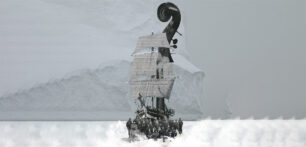

In March 2022, the Endurance22 expedition crew announced that they had finally found what they had been looking for off the coast of Antarctica, aboard an icebreaker oceanographic vessel. The wreck of the Endurance, lying over 10,000 feet underwater, had been located using state-of-the-art methods, including high-tech underwater drones. That three-masted ship had left Plymouth more than a century earlier, in August 1914, to conquer the still largely unexplored South Pole. Unfortunately, a few months later, it became hopelessly trapped in thick ice and eventually sank in November 1915. But the epic story of its crew, led by Captain Ernest Shackleton, has remained etched in memory: as soon as his ship was lost, the explorer braved the cold and blizzards with five volunteers to find help, launching a rescue expedition that brought all the members of his crew back to safety.
This extraordinary story inspired composer Graciane Finzi, Karine Lethiec and her ensemble Calliopée to create an immersive concert-narrative in November 2025 which plunges listeners into the heart of the Endurance expedition. In the composer’s own words, L’Odyssée TransAntarctic is “not simply a musical score but a ‘video-sound-musical’ work integrating acoustic research into an innovative performance model”. The music written by Graciane Finzi for the Calliopée Ensemble septet (string quintet, clarinet, and accordion) evolves in counterpoint with a soundtrack designed by Diego Losa. This electroacoustician has himself participated in polar expeditions as part of audiovisual projects. He recalls “intense silences, the cracking of ice, magical encounters” in a place “out of this world”.
Based on the writings and logs of the Endurance expedition, a text read by actor Charles Berling follows the thread of the odyssey. The narrative is enhanced by the participation of video artist Fanny Wilhelmine Derrier, who used images captured over a century ago by the expedition’s photographer, James Francis Hurley. From there, she has developed a truly visual creation, bringing this epic to life and immersing the viewer in the past.
“The story of this expedition invites us, 110 years later, to look both toward Antarctica and toward an example of pushing beyond one’s limits. This human adventure has miraculously survived to the present day and serves as an example for us today and for future generations, inspiring us to take action, to surpass ourselves, to attempt the impossible, and to strive to go further.”
Karine Lethiec
“The link between music and science, particularly in the field of marine science, reveals fascinating interconnections. Music is based on mathematical and physical principles, such as frequencies and sound waves, which are also essential for understanding underwater acoustic phenomena. Scientists study the propagation of sound in water, which is crucial for applications such as marine communication and oceanographic exploration.
Electroacoustic music, in particular, illustrates this synergy. It combines musical composition with electronic technologies and acoustic principles, using tools such as synthesizers and audio processing software. Experimentation in electroacoustic music allows artists to explore new forms of sound, just as scientists discover new methods for studying and understanding the marine environment.
In short, electroacoustic and instrumental music represent an enriching fusion of musical creativity and advanced science, illustrating how these two fields can enrich each other, particularly in the context of marine science.”
Diego Losa