“As to music, I can say right off the bat that it has filled half of my life…”
I discovered your work when we met after my election at the Académie des Beaux-Arts. I was struck by your sense of energy, of animation. Your paintings and tapestries seem to be in perpetual motion, but also heirs to a form of structuralism through their strict construction. Would you define yourself as a creator of an art synthesis?
Frankly, I have never considered tying my work to any art movement, school or doctrine. I have never tried to “position” myself in relation to others or history. This issue is totally foreign to me. I have always preferred to journey alone. I have left it to the “experts” to pigeonhole me, to link me to certain trends – which, incidentally, may have unsettled some of them because my work ultimately seemed unclassifiable, and even esoteric, to them.
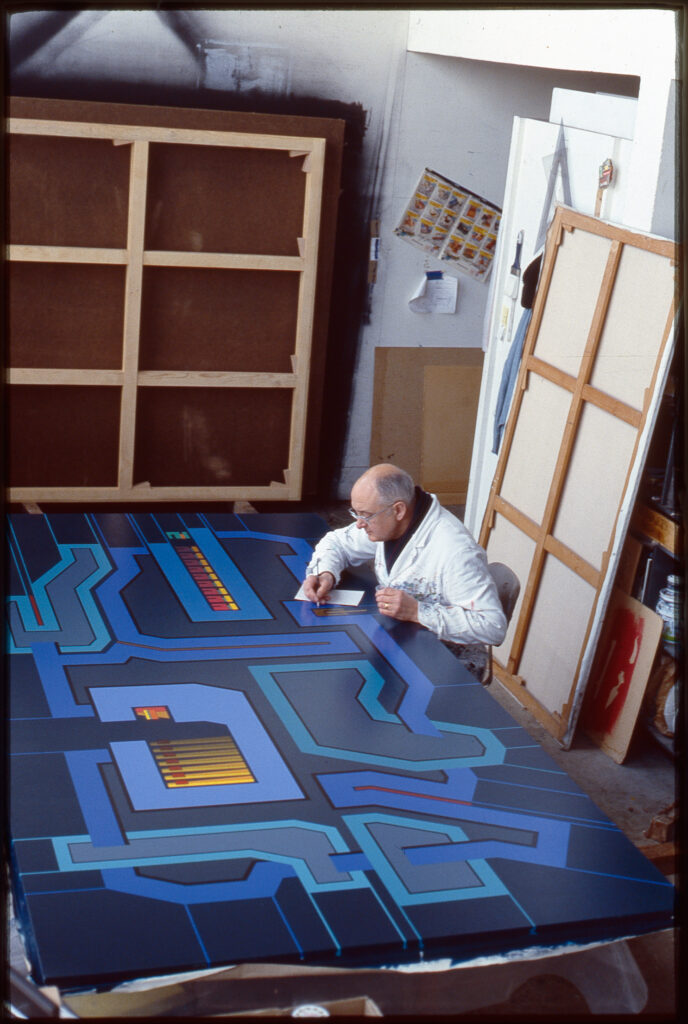
My works are merely the outcome of a profound desire to create, compose, and organise patterns – whether simple or complex, calm or tormented, violent, depending on times, on periods in my life. A question of mood… It’s a sort of graphic game the rules of which I set myself, an always rigorous game.
Let’s say that my visual language situates me within a form of geometric abstraction, occasionally marked by surrealism.
A few months ago, I received an offer to take part in an exhibition called “Eccentric Abstraction”. This only confirms the difficulty of classifying me. So, the term “synthetic” could possibly qualify my work – although a synthesis synonymous with liberty!
Your production shows rare homogeneity. How would you define your style?
At the beginning of my career, when I started creating tapestry cartoons, I didn’t have a style, I was searching for myself.
You should disregard the first ten years of my production devoted to tapestry, as I was exploring various forms of expression – with a mix of eagerness, passion, but also puzzlement, uncertainty, and doubt.
It made me happy, but I felt that my style was incomplete, imperfect, that I couldn’t find my “true” path. That path appeared when I started to paint, in 1963, and from then on it confirmed, and asserted itself for good.
Music and visual arts are based on two different perceptions. In the first case, the composer defines a time frame to which the audience is subjected. In the second case, the viewers receive the work instantaneously and then forge a path for themselves, defining its course and duration. What do you expect from someone discovering one of your works? What response do you hope to elicit from your audience?
It’s a delicate, difficult question. The strictness – some might call it dryness – of my pictorial writing can either disturb or attract people. In any case, my work generally surprises and intrigues viewers. Attraction, rejection, indifference – there is such a wide range of responses!
I expect from whoever discovers my work to at least acknowledge what I have accomplished, to respect my approach, even if it’s not to their taste. On the other hand, if a person is touched, or interested, I’m profoundly happy to be understood without needing to provide explanations on the meaning of my research, of my approach.
As an Academician, you have met artists from many disciplines. Who are those who have nourished you the most intellectually? And what is your relationship with music?
All of them brought me their share of discovery, of revelation, of deeper knowledge of fields I hardly or poorly knew. These encounters have always been enriching, exciting and instructive.
As to music, I can say right off the bat that it has filled half of my life. It has been as essential to me as my painting. It was literally part of me, absolutely indispensable for me to function, to live, to create. It has been my “celestial opium”, an addiction!
I would need days to talk about it, to show the importance music has had in my life. To my great regret and sadness, apart from choir singing, I have never practised music, never played an instrument. But I cannot count the times when I compared the combination of sounds with that of my colours, the “sound canvas” of some musical movements with that of my own visual creations.
The organisation of sounds and colours – composition, ordering, transitioning – so many are the parallels between these two extraordinary worlds!
When I was stuck in my work, at a standstill, I would often turn on particular pieces of music, and almost instantly recover the momentum of my inspiration.
Interview carried out by Bruno Mantovani on 9 July 2025.