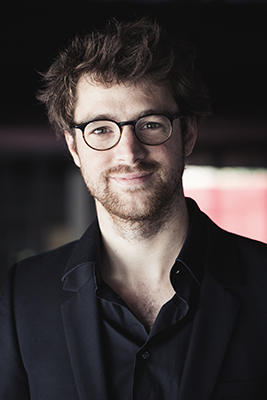
PLAYING BACH A. Lepage, F. Vicens et J.-B. Leclère

Friday 03 April ı 7:30 PM
Lycée Rainier III, Atrium
7:30 PM - CONCERT - Lycée Rainier III, Atrium
<div>
<p class="Standard"><span lang="EN-US">Transcriptions of <b>Johann Sebastian Bach </b>(1685-1750)<br />
</span><span lang="EN-US">for accordion, clarinet and marimba &#8211; 75 min</span></p>
</div>
<div>
<p class="Standard"><span lang="EN-US">Transcriptions of <b>Johann Sebastian Bach </b>(1685-1750)<br />
</span><span lang="EN-US">for accordion, clarinet and marimba &#8211; 75 min</span></p>
</div>
<div>
<p class="Standard"><span lang="EN-US">Transcriptions of <b>Johann Sebastian Bach </b>(1685-1750)<br />
</span><span lang="EN-US">for accordion, clarinet and marimba &#8211; 75 min</span></p>
</div>
Without intermission

Transcriptions of Johann Sebastian Bach (1685-1750)
for accordion, clarinet and marimba – 75 min

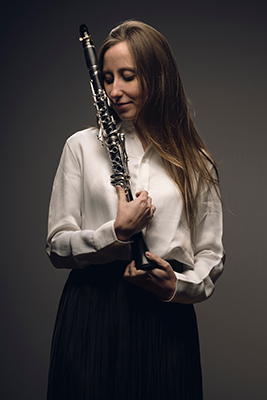
Ann Lepage, clarinet
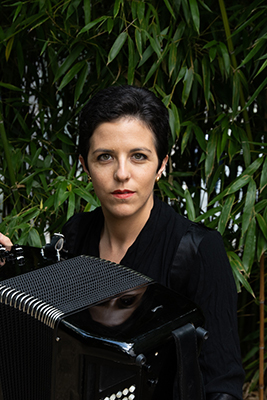
Fanny Vicens, accordion
Jean-Baptiste Leclère, percussion

The music of John Sebastian Bach generated a host of re-readings, transcriptions, arrangements, recreations and re-compositions. On the clarinet, the accordion and the marimba, Ann Lepage, Fanny Vicens and Jean-Baptiste Leclère take hold in turn of a number of masterpieces by the composer to, once more, renew the listening of this eternal music.

Concert prices

Online booking

You can book your tickets on Monte-Carlo Ticket website !
INFORMATION
PARKING

In general, the night rate is applicable from 7 p.m.: €0.20 every 15 minutes*

Except for the events for which the "Festival Printemps des Arts" show package applies

* Subject to change

More information

For Johann Sebastian Bach, composition and transcription were inextricably linked. His sixteen concertos, BWV 972-987, are the most famous example of this, all of them based on pre-existing works by other composers: violin concertos by Antonio Vivaldi and Georg Philipp Telemann, an oboe concerto by Alessandro Marcello, pieces by Prince Johann Ernst of Saxe-Weimar, and so on. This practice was commonplace at the turn of the 17th and 18th centuries. It allowed composers to understand and assimilate different styles, which they would then incorporate into future works. In a manner equally common at the time, Bach “transcribed himself,” using musical material previously created in another context and for another instrumentation in his own works. This was particularly the case with the Collegium Musicum in Leipzig, which he took over in 1729: to provide material for the numerous concerts given by this excellent ensemble, it was sometimes much more convenient to start from a work that had already been written than from a blank page. Thus, the Concerto for Flute, Violin, and Harpsichord, BWV 1044, draws freely from the Prelude and Fugue for Harpsichord, BWV 894, and from the central “Adagio” of the Organ Sonata, BWV 527.

Playing Bach’s works on instruments other than those originally intended is therefore anything but sacrilegious. Seeing Robert Schumann, Johannes Brahms, and Ferruccio Busoni adapt the “Chaconne” from the Violin Partita BWV 1004 for the keyboard is a natural extension of Bach’s transcribing his own work – such as one of his violin Sonatas and Partitas, transcribed for the keyboard (BWV 1003 into Sonata in D Minor, BWV 964). It seems that he made such adaptations on a regular and informal basis, according to one of his students, Johann Friedrich Agricola, who stated that Bach “added as much harmony as he thought necessary”!

At the beginning of the 20th century, transcriptions of Bach’s works began to diversify. Ferruccio Busoni, editor of a voluminous seven-volume Bach-Busoni Gesammelte Ausgabe (collected edition), is the finest example of this: some volumes consist of “arrangements” (Bearbeitungen) and “transcriptions” (Übertragungen), but the fourth volume focuses on ”compositions and free adaptations ” (Kompositionen und Nachdichtungen), paving the way for all kinds of re-compositional games. In 1985, Helmut Lachenmann added his own contribution to the post-Bach edifice by slipping a third voice of his own creation into the Two-Part Invention in D minor, BWV 775, demonstrating his mastery of counterpoint.

While a number of composers have “cooked up” Bach in their own way — from Arnold Schoenberg orchestrating chorale preludes to Pierre Schaeffer’s playful Bilude for piano and tape based on the second prelude of The Well-Tempered Clavier – it is above all instrumentalists who have tirelessly revisited the master’s works. The most tireless among them are musicians playing instruments that are “recent” in the history of written music, the art of transcription being indispensable for enriching their limited repertoire and giving them access to older styles. Such is the case with the accordion (invented in the 19th century), which lends itself particularly well to Bach’s music, offering characteristics similar to those of the organ – combining keyboard playing and wind handling.
This is also the case with the marimba, which has African roots but developed mainly in Guatemala – where it was declared the national instrument in 1821, when the country gained independence – before being fitted with resonators and incorporated into orchestras in the early 20th century. Marimba players have long been engaged in transcribing Bach’s works, facing a challenge: although their instrument has a range comparable to that of the keyboard, they do not have ten fingers but only two or four sticks; so they have to redouble their agility (or use subterfuge) to play the harmony written by the composer in the case of a piece for keyboard. Similarly, marimba players have to use their imagination to find a gesture similar to that of a bow on strings when attempting to interpret a piece for solo violin or cello. The musician is then faced with the questions that Bach inevitably asked himself when writing his Suites for cello or his Sonatas and Partitas for violin, two instruments that are monodic in nature and therefore not particularly conducive to harmonic discourse: how can the intrinsic limitations of an instrument be compensated for in order to make it perform the text we wish to entrust to it? The rules have not changed, and the possibilities are endless: it is now up to Ann Lepage, Fanny Vicens, and Jean-Baptiste Leclère to provide their answers.

Tristan Labouret

Get the latest news
from the Printemps des arts

Rejoignez-nous
sur instagram