
The Italian monodic laudes are an absolutely fascinating literary and musical phenomenon on the borderline between popular and scholarly culture. It is the first Italian repertoire in the vernacular. An expression of popular devotion, they were a defining feature of the life of religious brotherhoods in Tuscany and Umbria between the 13th and early 16th centuries. They are collected in various « Laudarii », anthologies of devotional poetry. The Laudario of Cortona (late 13th century) and that of Florence (Magliabechiano 18, early 14th century) are the only two manuscripts of monodic Italian lauds preserved with their musical notation.
Charming, delighting, teaching, and bringing people together are part of the purpose of brotherhoods, especially the “lausedi” (singing societies or brotherhoods) created to sing the praises to the Virgin Mary. Lauds are directly in line with the vocation of a brotherhood, a lay group that plays an important role in religious and city life, both charitable and cultural. They are part of the spiritual movement of Saint Francis of Assisi. Music is a means of spiritual elevation and a mode of expression of praise, an active vehicle for poetry. Like painting, it must touch the listener directly. The singing must respond to the musicality of the text, without affectation or bombast. The monodic lauds, not without a few clumsy moments, have a real charm and a true power of evocation. The poetry is not naive; it is precise, direct, melodious. Like many popular productions, it is sufficiently sophisticated to deserve the status of art in its own right.
All these lauds are composed in free rhythm, without a regular beat, a phenomenon that became rare at the end of the 13th century. The rhythm arises naturally from the structure of the text, the melody itself, and its modality. For the instrumental pieces, apart from the motet (briefly noted in the Cividale manuscript – 14th century), we have chosen a few lauds which, freed from their text, can be interpreted in a measured rhythm. They provide a basis on which musicians can ornament, develop and improvise.
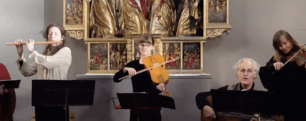
A Swiss composer and violinist fascinated by improvisation, Helena Winkelman composed “O divina virgo” for tenor, soprano, narrator, and four instruments (traverso and vielle, oud, and violin) based on a text from the same Laudario. The score, rich in melismas, reflects the composer’s keen interest in ornamentation, fueled by her passion for Indian classical music. The importance given to the middle register, which stems from the vocal and instrumental ranges of the project, opens up numerous possibilities for microtonal friction in a work that also explores modes and reference notes that guide the harmonic orientation of the piece.
As is often the case, my practice of an ancient repertoire – in this case, Italian monodic lauds, often shared with other devotional repertoires such as Cantigas de Santa María, songs by Gautier de Coincy, etc. – stimulates the desire to write as well as to engage in dialogue with the past. The interpretation of very ancient music requires the musician to complete, arrange, and develop the existing material, which is often elliptical. This can naturally lead the performer towards the process of composition. Looking in the same direction, the compositions thus take another turn.
“Ave regina gloriosa” is written for two sopranos, two tenors, violin, vielle and traverso. It retains the structure of a strophic song with a refrain: refrain – 1st stanza – instrumental interlude – 2nd stanza (more developed) – refrain… Although the composition uses polyphonic developments (harmonic and contrapuntal), it tends to preserve the direct character of the lauds style by respecting the prosody and structure of the text.
From the 13th to the 16th century, the lyrics of lauds inspired Italian composers. Today, with the rediscovery of ancient repertoires comes a new desire to write and this repertoire continues to stimulate creativity.
Dominique Vellard