

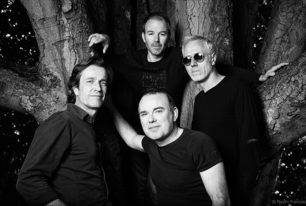
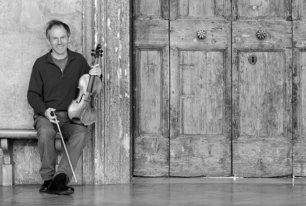
The latest project from our instrumental ensemble Caravaggio, Thirteen Ways of Being a Blackbird brings together 13 moments that are alternately “songs” or instrumental pieces, composed alternately by Benjamin de la Fuente and Samuel Sighicelli, for six musicians. The four pillars of the group – Bruno Chevillon (double bass), Benjamin de la Fuente (violin), Eric Echampard (drums, percussion, and electronic pad), and Samuel Sighicelli (synthesizers and sampler) – thus welcome two guests: Garth Knox (viola, viola d’amore, vielle) and Diamanda La Berge Dramm (violin and vocals).
Before being commissioned by Printemps des Arts de Monte-Carlo, we had been wanting to create a Caravaggio programme with vocals for about ten years. But since we didn’t want to put the group in the static position of accompanying a singer – that would no longer be Caravaggio – it took us a long time to find the right formula for this project. We wanted someone with a strong connection to the group who could also stand out and bring something unique to the vocals. We found that person in Diamanda La Berge Dramm. An accomplished solo violinist, this Amsterdam-based artist has never stopped expanding her musical palette, developing exciting work around her singing voice with her violin, sometimes using an electric violin.
An additional excitement is that of writing for a string quartet made up of four unique soloists, including guest artist Garth Knox, a promising contribution of colours and gestures to the project. The voice of Diamanda La Berge Dramm, whose emotional power animates her pure timbre, carries through the concert without being placed at the centre or front of the stage, as one might expect of a solo singer. The code of singing as a figure in the background is blurred here, not only by the singer’s off-center position on stage, but also by the fact that she alternates between singing and playing the violin, her original instrument. The fact that the voice is not ever present is above all a way for us to make it more precious, more necessary, more magical.
Thus, we consider the six musicians as being an entity with changing colors and functions, within which synergies emerge depending on the moment. The four string instruments come together, the drums join forces with the double bass, the vocals blend with the strings, the strings with the keyboards, the sampler plays with the drums or the vocals, etc.
With this creation, we once again aim to explore and broaden our palette, welcoming the voice and violin of Diamanda La Berge Dramm and the instruments of Garth Knox by modifying the group’s architecture and adapting roles: no electric bass, for instance, working on a new drum sound with the use of triggers, keyboards designed both as string orchestration and an integral part of the rhythm section, etc. The writing for the four strings will be rich in variety, ranging from a contrapuntal approach that highlights the singularities of each instrument to an orchestral approach. Enriched by sampling on the keyboards, it will provide an expressive counterpart to the “rhythm section” consisting of drums and electronic keyboards. In addition, each instrumentalist has their own set of electronic processing devices (analog pedals, digital effects), which will contribute to the unique sound of this “string section”.
The musical language is in line with Caravaggio’s work, which forms the basis of the orchestra. This language is marked by an approach that draws on contemporary jazz (emphasis on rhythm and energy), creative music (improvisation, use of digital and analog processing), and contemporary orchestral music (composition, use of space, density, and timbre similar to that of a contemporary orchestra). The combination of these different aesthetics and a “pop” voice makes Thirteen Ways of Being a Blackbird an original, mixed and hybrid project.
The title is taken from the long poem “I Mean” by Kate Colby, a contemporary American poet. All the lyrics in this creation are taken from this poem. It is a long litany in which each line begins with “I mean,” a reflective, energetic, and sometimes absurd ramble about the author’s body immersed in a bath that becomes the scene of great maritime, spatial, chemical, and philosophical flights of fancy.
Samuel Sighicelli and Benjamin de la Fuente