


LA GRANDE BATTLE Ensemble I Gemelli

Friday 13 March ı 7:30 PM
Musée Océanographique
Before & After
6:00 PM — LECTURE — Conseil National

“Virtuosity in Vivaldi” 
Adèle Gornet, musicologist

Reservation
7:30 PM — CONCERT — Musée océanographique
<p><strong><em>La grande battle</em></strong></p>
<p><strong>Vincent Carinola</strong> (1965-) – 5 min<br />
<i><span lang="EN-US">Métiers d’hier et d’aujourd’hui II : le chaman</span></i><span lang="EN-US">,<br />
</span>for virtual oboe (text by François Salès)<br />
World premiere</p>
<p><strong>Michel Petrossian</strong> (1973-)<br />
<em>Spenta Mainyu</em>, for modern oboe – 5 min<br />
World premiere</p>
<p><strong>Antonio Vivaldi </strong>(1678-1741)<br />
Arias for tenor and counter-tenor – 80 min<br />
Excerpts from <i>La fida ninfa</i>, <i>Farnace</i>, <i>Il Giustino</i>,<i> Orlando furioso</i>, <i>La Griselda</i>, <i>Bajazet</i>,<i> Tito Manlio, etc.<br />
</i><em>Concerto per oboe, </em>RV 455</p>
<p><strong><em>La grande battle</em></strong></p>
<p><strong>Vincent Carinola</strong> (1965-) – 5 min<br />
<i><span lang="EN-US">Métiers d’hier et d’aujourd’hui II : le chaman</span></i><span lang="EN-US">,<br />
</span>for virtual oboe (text by François Salès)<br />
World premiere</p>
<p><strong>Michel Petrossian</strong> (1973-)<br />
<em>Spenta Mainyu</em>, for modern oboe – 5 min<br />
World premiere</p>
<p><strong>Antonio Vivaldi </strong>(1678-1741)<br />
Arias for tenor and counter-tenor – 80 min<br />
Excerpts from <i>La fida ninfa</i>, <i>Farnace</i>, <i>Il Giustino</i>,<i> Orlando furioso</i>, <i>La Griselda</i>, <i>Bajazet</i>,<i> Tito Manlio, etc.<br />
</i><em>Concerto per oboe, </em>RV 455</p>
<p><strong><em>La grande battle</em></strong></p>
<p><strong>Vincent Carinola</strong> (1965-) – 5 min<br />
<i><span lang="EN-US">Métiers d’hier et d’aujourd’hui II : le chaman</span></i><span lang="EN-US">,<br />
</span>for virtual oboe (text by François Salès)<br />
World premiere</p>
<p><strong>Michel Petrossian</strong> (1973-)<br />
<em>Spenta Mainyu</em>, for modern oboe – 5 min<br />
World premiere</p>
<p><strong>Antonio Vivaldi </strong>(1678-1741)<br />
Arias for tenor and counter-tenor – 80 min<br />
Excerpts from <i>La fida ninfa</i>, <i>Farnace</i>, <i>Il Giustino</i>,<i> Orlando furioso</i>, <i>La Griselda</i>, <i>Bajazet</i>,<i> Tito Manlio, etc.<br />
</i><em>Concerto per oboe, </em>RV 455</p>
<p><strong><em>La grande battle</em></strong></p>
<p><strong>Vincent Carinola</strong> (1965-) – 5 min<br />
<i><span lang="EN-US">Métiers d’hier et d’aujourd’hui II : le chaman</span></i><span lang="EN-US">,<br />
</span>for virtual oboe (text by François Salès)<br />
World premiere</p>
<p><strong>Michel Petrossian</strong> (1973-)<br />
<em>Spenta Mainyu</em>, for modern oboe – 5 min<br />
World premiere</p>
<p><strong>Antonio Vivaldi </strong>(1678-1741)<br />
Arias for tenor and counter-tenor – 80 min<br />
Excerpts from <i>La fida ninfa</i>, <i>Farnace</i>, <i>Il Giustino</i>,<i> Orlando furioso</i>, <i>La Griselda</i>, <i>Bajazet</i>,<i> Tito Manlio, etc.<br />
</i><em>Concerto per oboe, </em>RV 455</p>
<p><strong><em>La grande battle</em></strong></p>
<p><strong>Vincent Carinola</strong> (1965-) – 5 min<br />
<i><span lang="EN-US">Métiers d’hier et d’aujourd’hui II : le chaman</span></i><span lang="EN-US">,<br />
</span>for virtual oboe (text by François Salès)<br />
World premiere</p>
<p><strong>Michel Petrossian</strong> (1973-)<br />
<em>Spenta Mainyu</em>, for modern oboe – 5 min<br />
World premiere</p>
<p><strong>Antonio Vivaldi </strong>(1678-1741)<br />
Arias for tenor and counter-tenor – 80 min<br />
Excerpts from <i>La fida ninfa</i>, <i>Farnace</i>, <i>Il Giustino</i>,<i> Orlando furioso</i>, <i>La Griselda</i>, <i>Bajazet</i>,<i> Tito Manlio, etc.<br />
</i><em>Concerto per oboe, </em>RV 455</p>
Without intermission

La grande battle

Vincent Carinola (1965-) – 5 min
Métiers d’hier et d’aujourd’hui II : le chaman,
for virtual oboe (text by François Salès)
World premiere

Michel Petrossian (1973-)
Spenta Mainyu, for modern oboe – 5 min
World premiere

Antonio Vivaldi (1678-1741)
Arias for tenor and counter-tenor – 80 min
Excerpts from La fida ninfa, Farnace, Il Giustino, Orlando furioso, La Griselda, Bajazet, Tito Manlio, etc.
Concerto per oboe, RV 455

François Salès, modern oboe and virtual oboe
Neven Lesage, baroque oboe
Emiliano Gonzalez Toro, tenor and conductor
Jake Arditti, countertenor

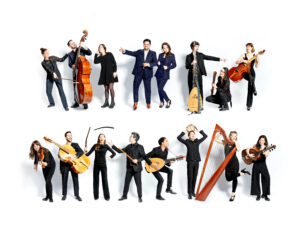
Ensemble I Gemelli
Stéphanie Paulet, Franciska Anna Hadju, Yoko Kawabuko, violin 1
Margherita Pupulin, Iris Maron, Csenge Orgovan, violin 2
Laurent Müller, Marta Paramo, viola
Hager Hanana, cello
Jérémy Bruyère, double bass
Violaine Cochard, harpsichord
Marie-Domitille Murez, harp
Miguel henry, theorbo
Neven Lesage, Sidonie Millot, oboe
Alejandro Pérez Martinez, bassoon

Mathilde Etienne, conception and staging

9:30 PM — AFTER — Marius Monaco
After sessions are reserved to concert ticket holders

with Emiliano Gonzalez Toro, tenor and Vincent David, saxophone

Reservation

It is not a concert, but a battle, and even a double battle, that will be proposed in this programme. On the one hand, two singers with very different voices – a tenor (Emiliano Gonzalez Toro) and a counter-tenor (Jake Arditti) will face each other in arias from operas by Vivaldi, accompanied by the excellent ensemble I Gemelli. On the other hand, three types of oboes will come in succession – baroque, modern, and virtual – upon a surprising journey through time.

Concert Prices
Standard rate
20

Online booking

You can book your tickets on Monte-Carlo Ticket website !
INFORMATION
PARKING

In general, the night rate is applicable from 7 p.m.: €0.20 every 15 minutes*

Except for the events for which the "Festival Printemps des Arts" show package applies

* Subject to change

More information
THE GRAND BATTLE: PRE-MATCH

A conversation with François Salès, Emiliano Gonzalez Toro and Mathilde Étienne

Mathilde Étienne:  The purpose of this battle is that all is not defined ahead of time. We have prepared a sort of catalogue of Vivaldi arias which we’ll draw from, but there will be an element of chance according to the mood of the moment, and the response of the audience. I’ll play the part of the referee, announcing the programme by addressing the various challenges to the two virtuoso singers, counter-tenor Jake Arditti and tenor Emiliano Gonzalez Toro.

Emiliano Gonzalez Toro: Improvisation is for us a daily practice! I’m currently working on Vivaldi’s Farnace, which we’ll soon perform in Madrid and Paris. So, I’m writing the “da capo” for the singers. Because in all the songs of Vivaldi’s time, there is part A and a part B, followed by a “da capo”, a return to part A. When the singer returns to the initial part, he must vary and show that he masters the style, the ornamentation, the jump in pitch, the hold of the breath, while remaining faithful to the rhetoric of the text. In other words, it shouldn’t beautify a word that expresses something terrible, harsh, or cold, for example; embellishment must always reinforce the meaning of the text.

I’m thus writing some “da capos”  for the singers so that they have a catalogue of musical ideas at their disposal that they can choose from during the performance.

Mathilde Étienne: In the 17th and 18th centuries, opera was modeled after theatrical improvisation: actors in the commedia dell’arte learned their lines by heart; the aim of the game was then to use them at the right moment, to compose a coherent form from pieces of pre-existing text. For musicians of that era and for us today, it’s the same thing: everything depends on our memory and how we react. And the broader our repertoire, the more freedom we have, the more our imagination is called upon.

In singing competitions (which have existed for centuries), the speed of vocalization and the range of intervals were, of course, important criteria, but it was improvisation and imagination that made the difference. We can find accounts of great contests from the past, such as the competition won in the 19th century by Maria Malibran against a famous castrato of her time. The contest took place in several rounds and, after a while, the castrato “stalled”, unable to come up with new variations, while Maria Malibran seemed inexhaustible! It was on this parameter that she won, on improvisation.

Emiliano Gonzalez Toro:  It’s Jake who’s going to win, I’m sure! But I like the idea that I’ll be David against Goliath, it makes me want to fight.

Mathilde Étienne:  Emiliano does have some arguments in his favour: he is the fastest vocalist in the history of music – on a par with Cecilia Bartoli. And he has an extraordinary vocal colour, which can range from metallic to velvety, and is very flexible and expressive. His weapons are stronger than he cares to admit. Jake won’t be playing on the same field at all: a countertenor will use his range, especially if he has beautiful high notes, which is always very impressive! In fact, these are two very different voices, so it will be a matter of personal taste.

Emiliano Gonzalez Toro: In a previous life, I studied the modern oboe and obtained my conservatory diploma in Lausanne. So I’m particularly excited to propose these two battles jointly!

François Salès: It will be less of a battle between musicians than an organological battle, featuring three very different instruments. The oboe has evolved like the world at large: it became faster and more powerful. But this is not necessarily to the advantage of the modern oboe, which generates more tension than the more flexible baroque oboe. As for the virtual oboe, it’s not strictly speaking an oboe: it’s an electronic wind instrument that doesn’t require comparable physical involvement. It’s an evanescent object, perfect for the work that Vincent Carinola and I are doing: it allows us to summon imaginary worlds and talk with the dead. This is the subject of his piece Le Chaman, which is an excerpt from a one-hour solo show that we’re preparing together. So there will be three very different instrumental aesthetics.

François Salès: The instrumentalist is always struggling with his instrument! We’d like it to be under our thumb, to translate our every intention and thought. But that’s not the case; we struggle with it. In his painting Hell, Hieronymus Bosch depicts musicians chained to their instruments. He had it all figured out!


Interview conducted by Tristan Labouret
Get the latest news
from the Printemps des arts

Rejoignez-nous
sur instagram