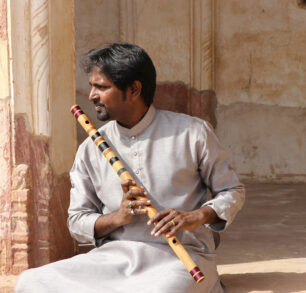

In South Asia, the bansuri flute is associated with Krishna, a major deity in the Hindu pantheon. Numerous stories and representations convey the attraction of cowherd girls (gopis) to this mischievous god, charmed by the sweet sounds and haunting melodies of his bamboo transverse flute. The instrument is found in many regional and devotional musical genres throughout the Indian subcontinent, under various names and sizes, before gaining a prominent place in the classical scene in the 20th century. From the 1970s onwards, the bansuri gained international fame at the hands of virtuoso instrumentalist Hariprasad Chaurasia. In its long version with six or seven finger holes and a range of more than two octaves, the bansuri has become an essential instrument at any Hindustani music festival, a genre of music considered “classical” in North India and also present in Pakistan, Bangladesh, and Nepal.
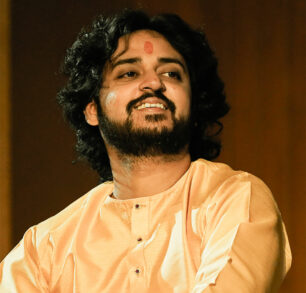
Rishab Prasanna belongs to a large family of Hindustani musicians from the holy city of Benares, renowned for their exceptional mastery of the flute and shehnai (oboe). He is the son and disciple of master Rajendra Prasanna, now based in New Delhi, the last performer in the family to have mastered both wind instruments. This musical environment allowed Rishab to become familiar, day after day, with the art of raga and the playing techniques that have made his lineage famous.
A key concept in Hindustani and Carnatic music, raga refers to the melodic framework of a piece of music; it is similar to a mode defined by an ascending and descending musical scale (which may differ), pivot notes, characteristic melodic movements and phrases, but also a time or season of playing, and a certain ethos. The most common definition of raga is “that which colors the mind”. Tala refers to the rhythmic cycle marked by the beats of the tabla, a pair of drums covered with goatskin and a central black patch made of rice starch and iron powder.
The tabla player always sits to the right of the soloist, while the tampura player sits slightly behind them. All classical recitals are accompanied by a tampura, a fretless lute with four or five strings tuned to the reference notes of the raga. The strings are plucked one by one in a continuous manner, creating a drone that is so characteristic of Indian classical music. Electronic and digital versions are now common and tend to double or even replace the acoustic instrument.
Rishab Prasanna’s repertoire is closely linked to vocal music, particularly the khayal genre, which originated at the turn of the 17th century in the cultural context of the Indo-Persian princely courts. At each recital, the musician offers a recreation of the raga based on a lyrical poem or short instrumental composition, the only fixed part of the performance. Various techniques of development and ornamentation – learned during extensive training with one or more masters – allow the performer to “extend” the raga. The musician thus begins with the alap, a short melodic prelude, and continues in a slow-tempo rhythmic cycle, before concluding with a highly virtuosic fast-tempo section. The artist’s virtuosity lies as much in the agility of the body as in that of the mind. As an Indian saying about learning music sums up, “first work with your body, then work with your mind, and finally put your heart into it”.
After an extensive presentation of a first raga, the artist develops one or two other ragas before offering shorter pieces from the regional repertoire. Dhuns (melodies) or seasonal songs (hori, caiti, kajri) are generally presented in ragas considered “light” music. The repetition of the theme with subtle spontaneous melodic and rhythmic changes, or nuances in timbre, creates aesthetic pleasure (rasa) for the discerning listener. Rasa is a central concept in Indian aesthetic thought. The role of the audience is also decisive in a Hindustani music concert: the level of listening contributes fully to the quality of the performance. Contrary to the codes of listening to Western classical music, the audience expresses its appreciation through hand gestures, head movements, and verbal interjections. However, you don’t need to be a connoisseur to appreciate the meditative and exhilarating aspects of a Hindustani music recital. Let yourself be transported by the depth of the alap, the beauty of the flute’s flights of fancy, the delicate phrasing of Rishab Prasanna, as well as the improvised question-and-answer interplay between the bansuri and the tabla. This is the way to fully enjoy the experience and discover a rich musical tradition that has already won the hearts of many musicians and listeners around the world.
Ingrid Le Gargasson