

This programme explores the depth of a repertoire inspired by the Passion and the Penitence. Works by Bach frame emblematic pieces of 20th-century French organ music. First, let us underline the special relationship between the three modern composers involved: Marcel Dupré taught organ and improvisation to Olivier Messiaen, who was Jean-Louis Florentz’s composition teacher.
The chorale “Erbarm’ dich mein, o Herre Gott” (Have mercy on me, Lord my God) BWV 721 by Johann Sebastian Bach, passed on via a copy made by his cousin Walther, is thought to have been written around 1710. This piece, inspired by Psalm 50, features a rather unusual accompaniment of repeated chords, like a slow string tremolo, which his teacher Dietrich Buxtehude, among others, was familiar with. Bach may also have been inspired by a beautiful cantata of the same name by the Estonian composer Ludwig Busbetzky.
We leap forward two and a half centuries to find Olivier Messiaen at the grand organ of the Église de la Sainte-Trinité in Paris, one evening in March 1955. Pierre Boulez had organised the premiere of his teacher’s Livre d’orgue (1951) as part of the Domaine musical concerts. Two thousand people filled the church for this event! “Les mains de l’abîme” (The Hands of the Abyss) is the third piece in the cycle. Composed in the mountains of the Dauphiné region, it expresses the distress and imploration of man who has reached the bottom of the abyss. It can be seen as an allusion to Psalm 129, De profundis: “From the depths I cry to you, Lord, Lord, hear my call! Let your ear be attentive to the cry of my prayer!”Messiaen’s striking composition contrasts the lowest notes with the highest, creating an immense and terrifying space.
Bach treats this theme in a completely different way, paraphrasing the chorale melody of Psalm 129. “Aus tiefer Not” BWV 686 is one of the masterpieces of the third part (1739) of the Clavier-Übung (keyboard exercises) collection. This work, a sort of instrumental counterpart to the forthcoming Mass in B minor, shows a composer at the pinnacle of his art, moving with virtuosity from the most severe ancient style to the most modern Italian style. Here we see the master of vocal counterpoint transposed to the organ at work, with a grand ricercare, a six-voice fugal form “pro organo pleno” that offers a sixth entry in long notes to the tenor voice, on the right pedal, with the bass provided by the left pedal.
Another journey through time is proposed by Jean-Louis Florentz, himself a tireless traveler. With a background in science and steeped in African culture, he composed music whic his both complex and refined, yet powerful and direct in its expression. Laudes are his first score for organ. His composition spans a little over ten years (completed in 1985, with the first sketch dating back to 1973). Seven pieces, as in Messiaen’s Livre d’orgue, make up a cycle dedicated to the figure of the Virgin Mary, mother of Heaven and of paramount importance to Ethiopian Christians at a time when they were suffering intense persecution. The fifth piece in the collection, “Pleurs de la Vierge” (Tears of the Virgin), evokes Mary’s despair. The composer said he conceived these tears as a “flow of metal”; in this case, it is a figure upon a solo mixture stop played on the pedalboard. “Rempart de la Croix” (Bastion of the Cross), the penultimate piece, is an eloquent musical moment, the opening bars of which are a self-quotation from his sublime Requiem de la Vierge. A play on harmonics (notably the unusual seventh) and the use of a melody from the Nuba people (Sudan) give it a very distinctive sound in its central section.
A key figure in 20th-century French music, Marcel Dupré gave an initially improvised performance of a cycle of fourteen Stations of the Cross, alternating with a powerful text from Paul Claudel’s Bréviaire poétique, recited by Madeleine Renaud. The written score dates from 1932. The seventh station, “Jesus consoles the daughters of Israel who follow him”, is tenderly expressed. Later in the programme, the last station, crepuscular, responds to it, largely reprising the same theme in a somewhat Wagnerian atmosphere.
Bach’s partita Sei gegrüsset, Jesu gütig, BWV 768, usually translated as “Hail to you, merciful Jesus”, is the longest and also one of Bach’s earliest works for organ. The word “partita” refers to the parts of a whole. It is therefore a series of eleven variations on a chorale melody given at the beginning, in which Bach displays a bewildering variety and quality of inspiration. The first part, generally dated to the time when Bach was a choirboy at the Latin school in Lüneburg, is designed without a pedalboard. On a French-style opening rhythm, in the middle of the work, the pedal part enters, inaugurating the majestic portico of the second part. The music seems to fade away a few minutes later on a kind of sarabande with a pietistic expression, before returning to a final harmonisation of the chorale in an expression that is both painful, grandiose, and filled with hope.
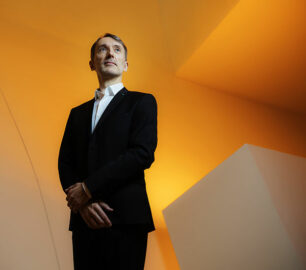
Éric Lebrun